
Energy storage just crossed a threshold that solar took eight years to reach and wind took fifteen. According to a new analysis from BloombergNEF published May 7, 2026, global energy storage deployment exceeded 100 gigawatts of annual additions for the first time in 2025 — reaching 112 GW, up 48% from the prior year. BNEF forecasts 158 GW of additions for 2026 and projects the market to top 300 GW per year by 2036.
The numbers do more than mark a milestone. They reframe how the storage industry should be understood relative to other clean technologies, and they sharpen the questions investors, developers, and policymakers will be asking for the rest of the decade.
How fast was the scale-up
It took roughly four years for global energy storage to grow from 10 GW of annual additions to over 100 GW. By comparison, solar took about eight years to make the same jump, and wind took roughly fifteen, per BloombergNEF's analysis. That compression matters because the scaling curve directly shapes capital allocation, supply chain investment, and policy design.
Three factors explain the acceleration:
- Cost decline. The IEA's Electricity 2026 report noted that average global installed battery costs fell 58% between 2019 and 2024, from roughly US$511/kWh to US$213/kWh. BNEF's separate annual battery price survey has shown sustained declines into 2025.
- Manufacturing leverage. Battery cell capacity built primarily for electric vehicles can be repurposed for stationary applications. The industry did not need to build a parallel supply chain — it inherited one.
- Policy alignment. Capacity auctions, co-location mandates, and tax credits arrived at roughly the same time across multiple major markets, creating a synchronized pull from China, the United States, Europe, and Australia.
The geography is concentrated — but shifting
China accounted for 54% of additions in 2025, and the United States 16%, according to BNEF. That two-country concentration has been a feature of the storage market for several years. What changed in 2025 is the rate at which secondary markets accelerated.
Australian deployment rose nearly sixfold year-over-year, driven by favorable power market conditions in the National Electricity Market and a new federal subsidy scheme for residential storage. The country has now installed more than 380,000 home battery systems totaling 10.7 GWh under the Cheaper Home Batteries Program, per disclosures from Climate Change and Energy Minister Chris Bowen.
Saudi Arabia leapfrogged several peer countries in the same year as Chinese suppliers — primarily CATL, BYD, and Sungrow — began tapping the kingdom's solar-plus-storage tenders. Egypt, Chile, and several Central and Eastern European markets also saw breakthrough deployments.
The solar-to-battery ratio collapsed faster than expected
In 2016, the world deployed roughly 56 megawatts of solar for every 1 megawatt of batteries. In 2025, the ratio was 6:1. BNEF projects the ratio will narrow further to 4:1 in 2026, as storage additions accelerate even while solar additions slow.
That convergence has practical implications. Co-location is no longer a niche design choice — it is becoming the default configuration for new utility-scale projects in markets like Texas, California, Australia, and Spain. Interconnection queues across major US RTOs now show that the majority of pending solar applications include co-located storage, often in DC-coupled configurations that capture clipped energy and stack capacity value.
What 158 GW means for 2026
The forecast for 2026 implies another 41% year-over-year growth. To put that in context: the marginal capacity added in 2026 alone — roughly 46 GW — exceeds the total cumulative installed storage capacity that existed globally as recently as 2022.
BNEF's own forecast extension shows annual additions reaching 308 GW by 2036, supported by:
- Continued cost declines in lithium-ion cells
- Greater renewables penetration creating intraday price spreads that storage can monetize
- Co-location mandates in China, India, and several US states
- Capacity auctions in markets including Brazil's pending LRCAP-Armazenamento, the UK Capacity Market, Italy's MACSE, and various US ISO procurements
- Emerging applications: data centers, EV charging infrastructure, and industrial behind-the-meter
The Iran war is the headline risk — but supply chains are buffered
BNEF flags ongoing conflict in the Middle East as the most significant near-term wildcard for the storage market, but argues the direct impact has been limited to date. The reason is structural: China dominates the battery supply chain, and Chinese cell, electrolyte, and electrode material flows are largely insulated from Middle Eastern oil disruptions.
Receba os próximos artigos por e-mail
Conteúdo novo de World Bess direto na sua caixa de entrada. Sem spam.
The indirect effects could still matter. If sustained higher fossil fuel prices translate into elevated retail electricity tariffs across major markets, residential and commercial demand for solar-plus-storage installations could accelerate — replicating the European deployment surge that followed Russia's invasion of Ukraine. Higher oil prices also raise shipping and manufacturing costs at the margin, particularly for projects sourcing from Asia to Western markets.
The chemistry transition is starting
Lithium iron phosphate (LFP) accounted for over 90% of stationary storage additions globally in 2025, per BNEF. That dominance is unlikely to be displaced quickly — but the chemistry mix is starting to broaden in ways that matter for procurement and project economics.
Two trends stand out:
Long-duration storage is quadrupling. BNEF projects annual additions of long-duration energy storage (LDES, defined as 6+ hours of duration) will quadruple to 2 GW in 2026, with most growth coming from non-lithium technologies and concentrated initially in China. Iron-air, vanadium flow, and emerging gravity and thermal systems are reaching commercial scale where the economics of lithium-ion deteriorate at extended durations.
Sodium-ion is going industrial. In April 2026, CATL signed a three-year partnership with Beijing HyperStrong Technology totaling 60 GWh of sodium-ion batteries — the largest publicly announced sodium-ion order to date. US-based Peak Energy separately signed a roughly 5 GWh sodium-ion supply agreement with Jupiter Power for deployment between 2027 and 2030. Sodium-ion's long-term cost trajectory remains uncertain, but commercial validation has clearly arrived.
What the 100-gigawatt milestone really tells us
The 112 GW number is impressive in isolation. But the more revealing observation is that storage now scales at a rate that fundamentally changes the planning assumptions of grid operators, project developers, and capital allocators across most major markets.
A few practical implications:
| Stakeholder | What changes in the 100-GW era |
|---|---|
| Grid operators | Storage becomes a standard system resource, not an exception. Reliability planning models must treat batteries as dispatchable on the same footing as gas peakers |
| Utility-scale developers | Co-location is the new default; standalone solar without storage faces increasing economic disadvantage in most queues |
| Manufacturers | Cost competition shifts from cell pricing to integration, software, and lifecycle services. Differentiation moves down the value chain |
| Investors | Standalone storage IRRs depend increasingly on revenue-stack durability and curtailment risk, not capacity payments alone |
| Policymakers | Capacity market reforms, ancillary service product redesigns, and interconnection process modernization become urgent |
What to watch in 2026
Three signals will indicate whether BNEF's 158 GW forecast holds:
- Q3 2026 deployment data from China. Chinese provincial filings will provide the earliest read on whether co-location mandates and capacity auction outcomes translate into operating MW.
- The pace of US ITC monetization. The transferability mechanism under IRA Section 6418 is creating a deep secondary market for tax credits. If transfer prices remain near 90 cents on the dollar, project finance economics support the forecast trajectory.
- Sodium-ion deployment ramp. Whether CATL-HyperStrong delivers on the 60 GWh agreement at expected timelines, and whether Peak Energy and other sodium-ion players follow through, will determine whether 2026 is the year the chemistry mix structurally changes — or whether sodium-ion remains a 2027-2030 story.
The 100-gigawatt era is not a finish line. It is the new starting position for everything that follows.
Sources: BloombergNEF, "Energy Storage Enters the 100-Gigawatt Era: Three Things to Know" (May 7, 2026); IEA, Electricity 2026; pv magazine Australia, "Rebate change triggers record 2.4 GWh home storage registrations in April 2026" (May 7, 2026); Energy-Storage.News archive (May 2026); CATL and Beijing HyperStrong Technology corporate communications.
Related Posts
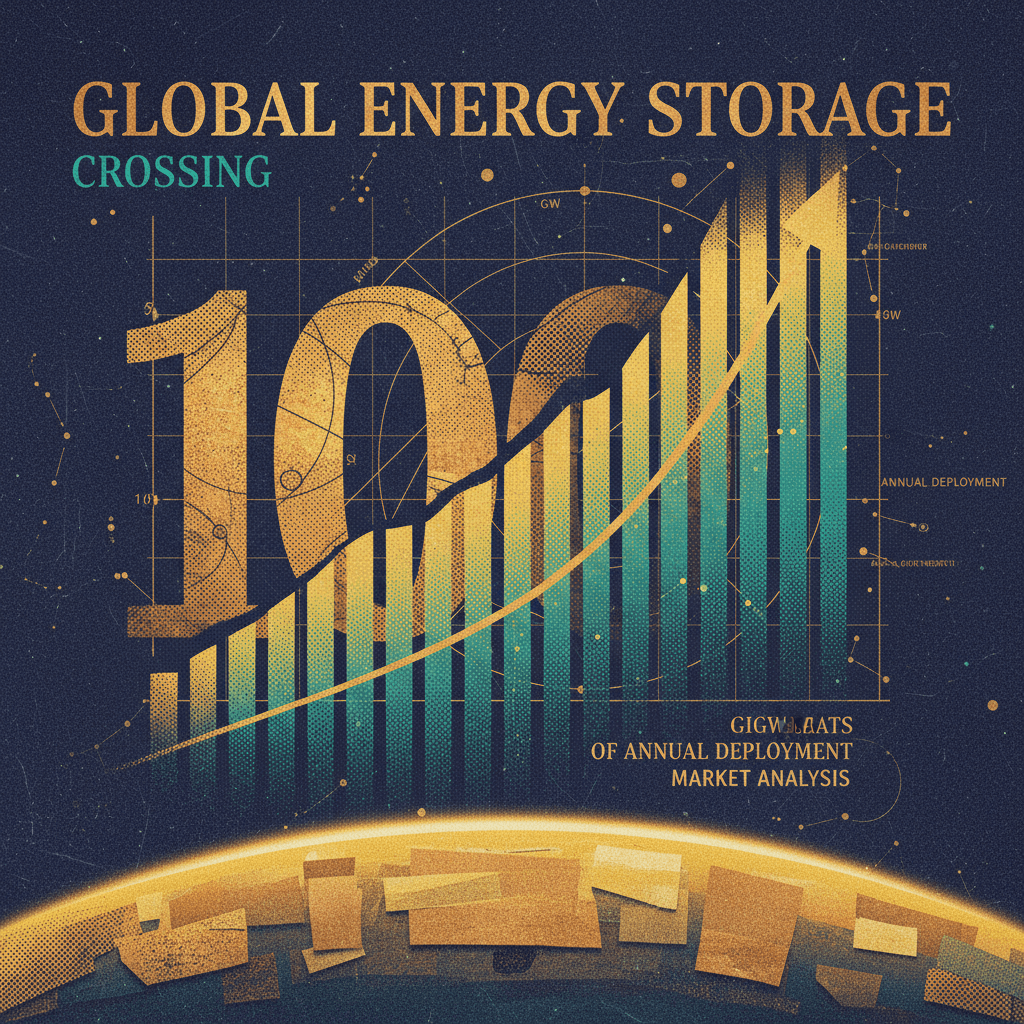
BloombergNEF: Storage Hit 112 GW in 2025, Crossing the 100-Gigawatt Threshold
BloombergNEF reports global energy storage deployment hit 112 GW of annual additions in 2025 — crossing the 100-gigawatt threshold for the first time and forecasting 158 GW in 2026. Inside the numbers and what they mean for the rest of the decade.

CATL's 60 GWh Sodium-Ion Bet Marks Storage Industry's Post-Lithium Pivot
CATL and Beijing HyperStrong signed a 60 GWh sodium-ion battery partnership in April 2026 — the largest publicly disclosed sodium-ion order to date. With LFP at 90% of stationary additions in 2025 and BloombergNEF projecting non-lithium long-duration storage to quadruple in 2026, this is the moment sodium-ion moves from chemistry experiment to industrial procurement.
CATL 60 GWh Sodium-Ion Deal: Industrial-Scale Validation for Post-Lithium
CATL's 60 GWh sodium-ion partnership with Beijing HyperStrong, announced April 2026, is the largest publicly disclosed sodium-ion order to date. It signals chemistry diversification has crossed from research milestone to commercial reality — but doesn't mean lithium iron phosphate is going anywhere.

Global BESS Market Outlook 2026: Capacity, Trends and Key Players
A data-driven look at the global battery energy storage market in 2026 — installed capacity, regional leaders, leading manufacturers and the trends shaping the next phase of growth.