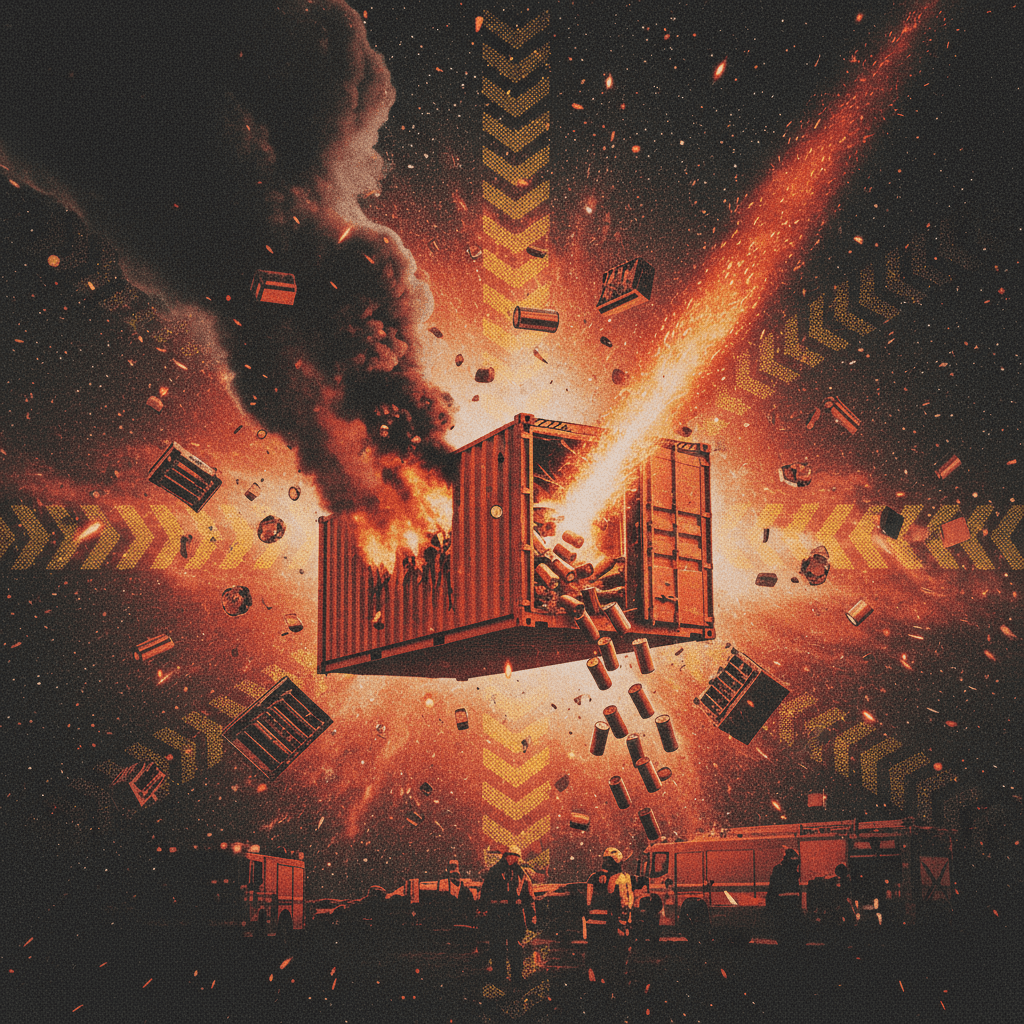
A fire at Moss Landing on January 16, 2025 forced the evacuation of roughly 1,200 to 1,700 residents, sent toxic black smoke over nearby communities, and consumed about 40% of the site’s stored batteries by the following morning. For the BESS industry, the immediate implication was hard to ignore: scale without robust containment, suppression, and hazard management can quickly become a public-trust crisis.
The incident at one of the world’s largest lithium battery storage facilities did not produce injuries or fatalities, and EPA air monitoring did not show sufficient hydrogen fluoride gas or particulate matter to create public risk. But the event still became a turning point. It exposed how older utility-scale storage designs, legacy code assumptions, and site-specific architectural choices can amplify consequences when a failure escapes its first layer of control.
That is why Moss Landing matters beyond California. As Ric O’Connell, cited by POWER Magazine, put it, “The lessons learned from Moss Landing will not only shape the future of energy storage in California, but also serve as a blueprint for the nation.”
The Moss Landing fire became a public safety event, not just an equipment failure
On the afternoon of January 16, 2025, a significant fire broke out at the Moss Landing Power Plant in Monterey County, California. The facility, which began operations in 2020, houses one of the world’s largest lithium battery storage systems.
The operational facts alone explain why the incident resonated so widely:
- January 16, 2025: date of the fire
- 1,200 to 1,700 residents evacuated: depending on the source cited
- 40% of stored batteries consumed: by the morning after the fire began
- No injuries or fatalities reported
- 6 pm on January 17, 2025: evacuation orders were lifted
The smoke plume raised immediate concern because burning lithium batteries can release hazardous gases. According to EticaAG’s reporting, the toxic smoke included carbon monoxide and hydrogen fluoride. Firefighters did not attempt to extinguish the batteries directly. Instead, they contained the fire within the facility perimeter and allowed the batteries to burn out.
That response was not incidental. It reflected the reality of large-scale lithium battery fires once thermal events propagate beyond initial controls. The industry has long discussed thermal runaway in technical terms. Moss Landing translated that risk into something much more visible: evacuation orders, air monitoring, and community scrutiny.
Monterey County Supervisor Glen Church captured that shift in public perception at the county’s January 17 press conference. “If we’re going to be moving ahead with sustainable energy, we need to have safe battery systems in place,” Church said. He added that residents “want to know why this happened,” “how it happened,” and “what can be done to prevent it [from happening] in the future.”
In a separate characterization cited by Energy-Storage.News, Church called the event a “wake-up call for this industry.”
Moss Landing exposed how legacy design choices can collide with newer safety expectations
The precise cause of the fire remains under investigation. Even so, the reporting cited in the research brief points to several factors that have already drawn industry attention.
First, the facility was built before some current fire codes and industry standards for large-scale battery storage were fully established. That timing matters. Moss Landing began operations in 2020, during a period when utility-scale storage was scaling quickly but some of today’s more mature safety expectations were still evolving.
Second, POWER Magazine reported that the fire suppression system in one of the battery racks failed, allowing the fire to spread. In any high-density storage environment, that kind of failure changes the event from a localized incident into a system-level test of compartmentalization and propagation control.
Third, the site used NMC lithium-ion batteries. The fact pack does not support broader claims about chemistry performance in this specific event beyond that identification, but the chemistry choice is part of why Moss Landing has become a reference point in safety discussions across the sector.
A fourth issue was architectural. The Moss Landing facility was located within a repurposed turbine hall, rather than using the more typical containerized battery setup. According to the research brief, that non-containerized configuration presented unique challenges and likely contributed to the fire’s intensity.
Taken together, those details explain why Moss Landing is being treated as more than an isolated failure. The event sits at the intersection of three industry realities:
- older projects may not reflect the latest design assumptions;
- suppression failure can quickly escalate consequences;
- site layout can be as important as battery selection.
That combination is what turns a fire into a broader safety reckoning.
The industry response is moving from compliance to preemptive risk reduction
One of the clearest takeaways from Moss Landing is that minimum compliance is no longer the only benchmark that matters. Developers, manufacturers, and operators are under pressure to show that projects can withstand abnormal events, not just meet baseline requirements on paper.
That shift was already underway before the January 2025 fire. According to Utility Dive, many manufacturers and project developers had already begun adopting best practices such as large-scale fire testing before regulations required them. After Moss Landing, that trend has more urgency.
This is where the incident changes the conversation. The question is no longer only whether a project is financeable, dispatchable, or fast to build. It is whether its design assumptions hold up under failure conditions that affect first responders, nearby communities, and local permitting politics.
Vistra spokesperson Sgro framed the company’s public position this way: “Safety is the first and foremost... and, after the incident is resolved and there is a thorough investigation, [it] will ensure the lessons learned are applied to prevent future incidents and inform safety standards and best practices.”
That statement matters because it points to the next phase of the industry response: investigation first, then codification. In practice, that means Moss Landing is likely to influence not just project-level engineering decisions, but also how owners communicate risk, how authorities assess siting, and how communities evaluate proposed facilities.
Another California fire reinforced that this is not a single-site issue. The research brief notes that the 250 MW Gateway project in Otay Mesa also experienced a fire in September prior to the Moss Landing incident. The brief does not provide additional operational detail, so the comparison should stop there. But the existence of another major California BESS fire adds weight to the argument that safety scrutiny is broadening across the market.
New mitigation strategies are focusing on both thermal events and toxic gas hazards
The post-Moss Landing response is not only about stronger codes. It is also about more layered mitigation strategies inside the project architecture itself.
Receba os próximos artigos por e-mail
Conteúdo novo de World Bess direto na sua caixa de entrada. Sem spam.
One lesson from the fire is that hazard management in BESS cannot be reduced to flame suppression alone. The Moss Landing event involved toxic smoke and gases, including carbon monoxide and hydrogen fluoride. That means the safety conversation now spans at least two linked problems:
- thermal propagation inside the battery system
- chemical exposure risk outside the battery system
That distinction helps explain why newer safety approaches are combining multiple technologies rather than relying on a single line of defense.
The research brief cites EticaAG’s integrated architecture as one example. The company combines HazGuard, aimed at toxic gas neutralization, with LiquidShield, an immersion cooling approach intended to address thermal hazards. The brief supports mentioning this as an example of the direction of travel in the market, not as an industry-wide standard.
The broader point is more important than any single vendor approach. Moss Landing showed that once a large battery fire is underway, the operational objective may shift from extinguishment to containment. If that is the case, then upstream prevention and early-stage mitigation become even more valuable.
That is also why project design choices are getting more scrutiny. A facility housed in a repurposed turbine hall presents different fire behavior and response challenges than a more modular, containerized layout. The research brief explicitly notes that Moss Landing’s configuration likely contributed to the fire’s intensity. For developers and owners, that raises a practical question: how much of BESS safety is determined before the first cell is ever energized?
The answer increasingly appears to be: a lot.
Standards are tightening, but Moss Landing also raises questions about the existing fleet
The standards landscape is moving. According to POWER Magazine, the upcoming NFPA 800 standard is expected to enhance fire safety in energy storage systems, building on UL 9540A and NFPA 855.
That progression matters because it suggests the industry is moving toward a more mature framework for evaluating and managing fire risk. But Moss Landing also highlights a more difficult issue: what to do about facilities that were built before some of those expectations were fully established.
That is not a theoretical concern. The Moss Landing facility itself began operations in 2020 and was built before some current fire codes and industry standards for large-scale battery storage were fully established. In other words, the industry is not only designing safer future projects. It is also reassessing whether parts of the installed base need retrofits, revised operating procedures, or more stringent emergency planning.
This is where public accountability enters the discussion. Glen Church’s comments were not limited to technical lessons. They reflected a political and social reality around utility-scale storage siting. If communities believe they are carrying poorly understood risk, every future project faces a steeper path.
Church’s warning was direct: the industry needs “safe battery systems in place.” That is not just a message for engineers. It is a message for developers, operators, insurers, local officials, and permitting authorities.
A useful way to frame the post-Moss Landing standards debate is through three layers:
- New-build requirements: stronger expectations for design, testing, and hazard mitigation
- Existing asset review: scrutiny of projects built before newer standards matured
- Emergency response alignment: clearer planning for containment, evacuation, and air monitoring
Moss Landing did not create those issues. It concentrated them.
What comes next for BESS safety after Moss Landing
The most important near-term milestone is still the same one that followed the fire itself: the outcome of the ongoing investigation into the precise cause of the Moss Landing incident. Until that process is complete, some of the industry’s hardest conclusions will remain provisional.
Several concrete developments are likely to shape the next phase of the discussion:
- Investigation findings: especially around ignition, propagation, and suppression-system performance
- NFPA 800 development and implementation: as the next major standards step beyond UL 9540A and NFPA 855
- Broader adoption of advanced mitigation technologies: including approaches aimed at both thermal control and toxic gas management
- Potential regulatory responses: particularly around older facilities built before current standards were fully established
- Community trust: which may become a gating factor for permitting and expansion in some markets
The EPA’s air monitoring results also remain part of the story. So far, monitoring has not shown sufficient release of hydrogen fluoride gas or particulate matter to create public risk, but monitoring is ongoing. That matters because future incidents will be judged not only by whether a fire occurs, but by whether operators and public agencies can demonstrate control over off-site consequences.
Moss Landing has already changed the terms of the conversation. A major BESS fire at a flagship-scale facility, followed by evacuations and a visible smoke event, made safety performance impossible to treat as a secondary issue. The next chapter will be written through investigation findings, updated standards, and whether the industry can prove that the lessons are being built into both new projects and the existing fleet.
If Moss Landing was the wake-up call, the real test starts now: how quickly those lessons move from post-incident commentary into project design, operating practice, and enforceable safety expectations.
Related Posts
AI Data Centers Are Becoming BESS's Biggest New Customer
Why hyperscale AI data centers are reshaping demand for grid-scale battery storage — colocation deals, behind-the-meter projects, and the new economics of AI-driven BESS deployment.

Global BESS Market Outlook 2026: Capacity, Trends and Key Players
A data-driven look at the global battery energy storage market in 2026 — installed capacity, regional leaders, leading manufacturers and the trends shaping the next phase of growth.

ERCOT Battery Storage Boom: How Texas Became the World's Largest BESS Market
How ERCOT became the largest grid-scale battery storage market in the world — the policy, market design and economics behind the Texas BESS boom.
Ørsted's Michigan BESS Buy and Morrow's Bankruptcy: BESS Industry's Two Speeds
On the same day in May 2026, Denmark's Ørsted bought a 150 MW Michigan battery project while Norway's Morrow filed for bankruptcy. The split tells the story of where capital is flowing in the BESS industry — and where it isn't.